The Goku simulations for cosmological emulation
The standard model of cosmology, known as the ΛCDM model, has been remarkably successful in explaining the large-scale structure of the universe. However, recent observations might suggest that the model is incomplete, motivating the need for more sophisticated models that can accurately describe the universe's evolution.
We performed the Goku simulation suite, a state-of-the-art cosmological N-body simulation suite designed for cosmological emulation. Goku covers a 10-dimensional parameter space that includes the ΛCDM parameters and key extensions--dynamical dark energy, massive neutrinos, the effective number of neutrinos and the running of the primordial scalar spectral index. The suite enables precise predictions for cosmological surveys like DESI, LSST, and Euclid, facilitating improved parameter inference and model testing.
Developed within the MF-Box framework, Goku combines high- and low-fidelity simulations, reducing computational costs by ~94% compared to traditional single-fidelity methods. We have built a Gaussian process emulator for the matter power spectrum, GokuEmu, which can predict the matter power spectrum with high accuracy in an unprecedentedly high-dimensional parameter space.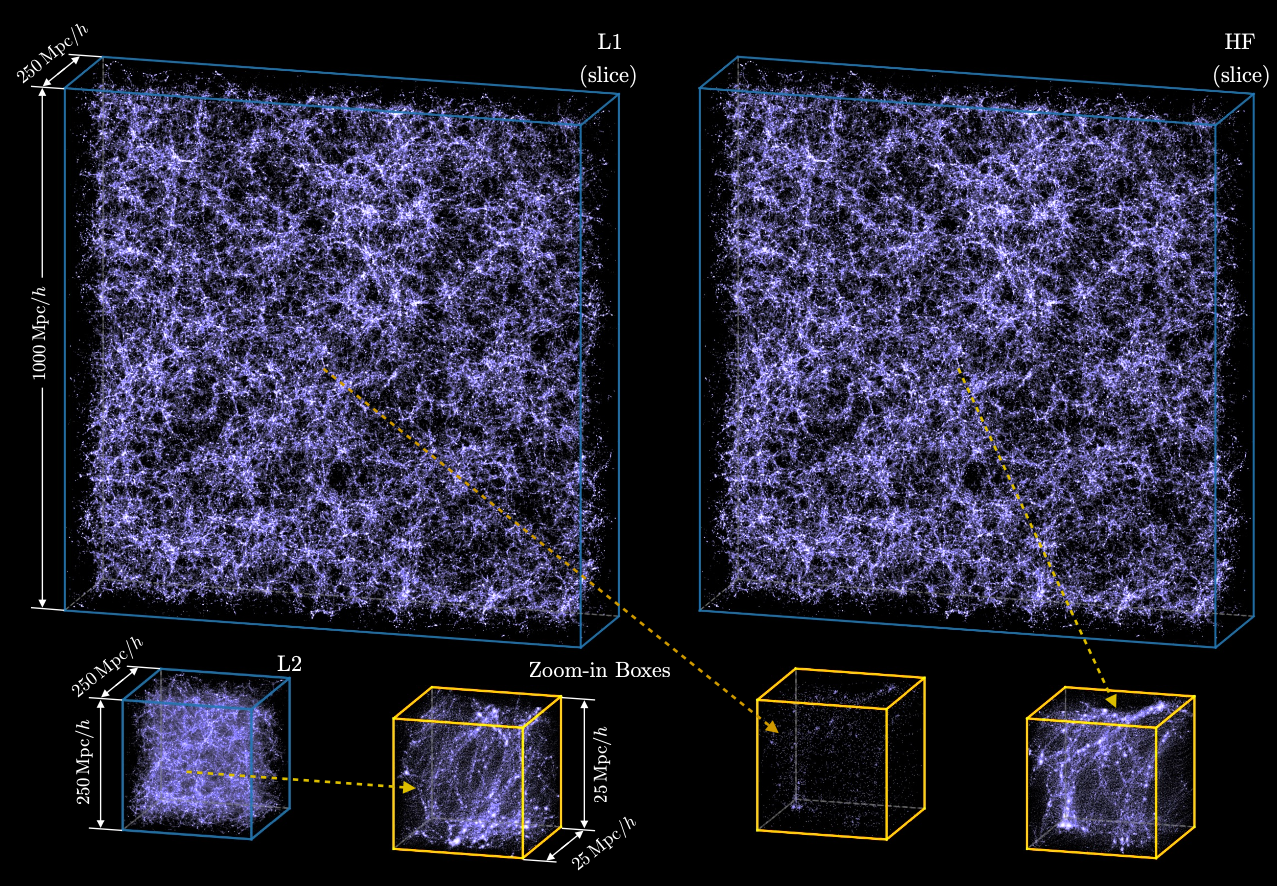
Visualized matter density fields of one of the HF simulations at z = 0 and its LF counterparts
For more information, please find our paper Goku: A 10-Parameter Simulation Suite for Cosmological Emulation.
The Astrid simulation
As the largest ever cosmological hydrodynamical simulation completed to z=0 (present day), Astrid provides the best view of the predictions of the standard cosmological model for a wide range of topics in galaxy and structure formation. One of the most timely will be the ability of Astrid with its detailed models of black hole formation and merging, to study the background of gravitational waves indicated by recent Pulsar Timing Array measurements. Another will be predictions for the Rubin Observatory's Legacy Survey of Space and Time. The large dynamic range of Astrid on one hand allows detailed studies of galaxy and massive black hole evolution at high resolution, and on the other hand allows systematic studies of rare massive systems with the large cosmic volume. Astrid is enabling studies of high redshift galaxies and black holes that are valuable for current and future observations such as the James Webb Telescope, LISA gravitational wave observatory, and DESI galaxy surveys.

For more information, please visit the Astrid website.
My role in the Astrid project involves running the Subfind halo-finding algorithm within the AREPO code to identify subhalos and galaxies in the simulation. This process is essential for analyzing the formation and evolution of galaxies and supermassive black holes. Additionally, I contributed to running the simulation down to z = 0. Currently, I am working on a dark matter-only version of Astrid, which will be compared to the hydrodynamical version to assess the impact of baryonic physics on large-scale cosmic structures.
Simulations of radiative turbulent mixing layers
Radiative turbulent mixing layers are ubiquitous in astrophysical environments, such as galactic winds, high-velocity clouds, and the circumgalactic medium. These layers arise from the interaction between hot and cold gas flows, leading to the mixing of different phases and the production of observable ions. Understanding the properties of these mixing layers is essential for interpreting observations of the circumgalactic medium and other astrophysical environments.
However, galaxy-scale simulations are unable to resolve the small-scale turbulent structures that are crucial for understanding the properties of these mixing layers. Instead, we have conducted small-scale hydrodynamic simulations of radiative turbulent mixing layers to study their properties and the resulting ion column densities, especially focusing on how the properties change with the shear velocity (thus the Mach number) between the hot and cold phases. We have found that the radiative TMLs saturate at high Mach numbers, leading to a plateau in the column densities of certain ions. This result has important implications for interpreting observations of the circumgalactic medium and other astrophysical environments.
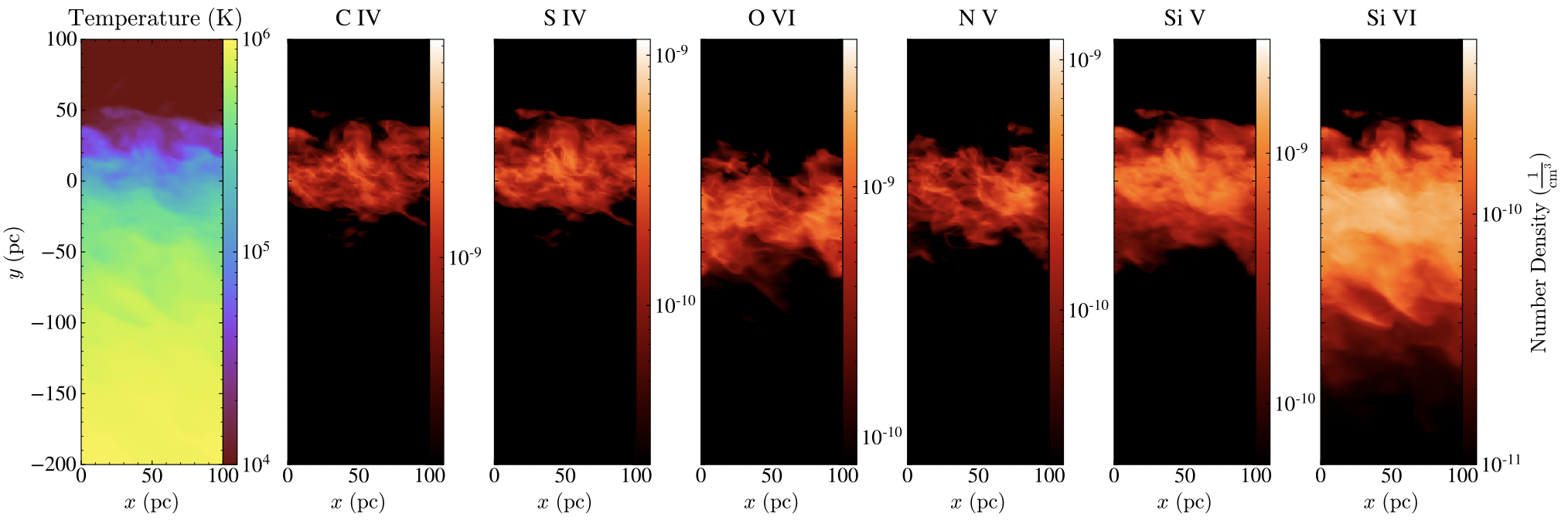
Projection of number densities of intermediate-temperature ions in the radiative TML
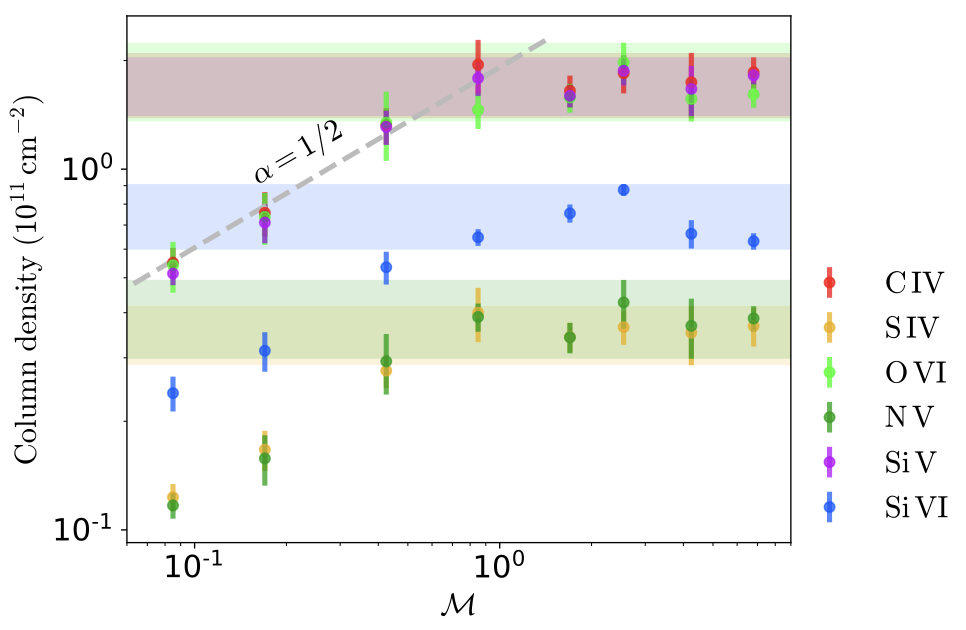
Column densities of ions saturate at high Mach numbers
For more information, please refer to our paper: Radiative turbulent mixing layers at high Mach numbers.